One simple journey on the surface. A five-party machine underneath.
Sign once
Go solar
Power on
One clear bill
What the homeowner experiences
Daylight · system of record & trust layer
Installer
Financing party
Payment processor
Provider
What Daylight orchestrates behind it
The setup
Trust, in a category built on distrust
Going solar is one of the biggest trust decisions a homeowner ever makes, in a category famous for bad sales and broken promises. It isn't signing a lease on a car. It's construction on your roof: inspections, township approvals, utility permission to operate, contractors, document management, financing, and payments moving between five parties over a decades-long agreement.
Daylight is the consumer energy platform that makes all of that feel like one simple, white-glove journey. I joined as the founding product engineer and have designed and architected the platform end to end — the origination portal, the homeowner app, billing, partner payments, and the design system that ties them together.
The problem
Orchestration, not screens
The hard problem wasn't any single screen. It was orchestration: how do you move a home through sale, verification, engineering, permitting, construction, and activation — with a sales rep, a reviewer, an installer, and a homeowner all playing their part at once — without the deal stalling and without the homeowner ever feeling the machinery?
Every phase has its own owner, its own failure modes, and its own paperwork. The product has to make the current state, the blocker, and the next action obvious to whoever is holding the project right now — and keep the homeowner's experience calm the whole way through.
The platform
One system of record. Five surfaces.
01
Origination portal
B2B · Web
02
Homeowner app
B2C · iOS
03
Billing
Money in
04
Partner payments
Money out
05
Design system
Craft
Surface 01 · B2B Web
The origination portal
The portal carries a project through six gated phases — origination, document verification, CAD design & true-up, permitting & interconnection, installation, and permission to operate. A project can't advance until its phase is genuinely complete: contracts generated and signed, identity and title verified, designs approved, inspections passed.
Each phase carries its own review gate, where a dedicated reviewer approves the work or sends it back with structured, actionable feedback.
The turning-point release was nailing the signing moment: exactly what we need from a customer at the point of signing their agreement — city-specific disclosures, identity verification, and contract signature in one guided flow that educates them on what they're signing up for. High-stakes paperwork, as little friction as possible.
Site survey · design approved with the customer · work order signed
Gate · as-designed matches as-sold
04Permitting & interconnection
Local permits · utility interconnection
Gate · review approved
05Installation
Install photos · close-out package
Gate · inspection passes
06Permission to operate
PTO letter · billing onboarding · certificates signed
Gate · billing may begin
Four roles · one project
Everyone plays their role at once
A sales rep moves the deal through document verification. A reviewer approves or rejects with reasons. An installer runs site survey, CAD design, and true-up amendments so what gets installed matches what was sold — then carries it through inspection to permission to operate. The homeowner signs, uploads, and stays informed.
Each party sees their own view of the same project, scoped by role and organization, and the handoffs between them are explicit product surfaces — not emails and spreadsheets.
Handoffs · phase by phase
Who's carrying the project.
01 Orig.
02 Docs
03 Design
04 Permits
05 Install
06 PTO
Homeowner
Sales
Installer
Reviewer
Leads the phase
Active in the phase
01Origination
Sales leads. Homeowner shares info; installer scoped in.
02Document verification
Homeowner signs. Sales carries the package; reviewer approves.
Installer finishes. Homeowner onboards to billing; final review.
Surface 02 · iOS
The homeowner app
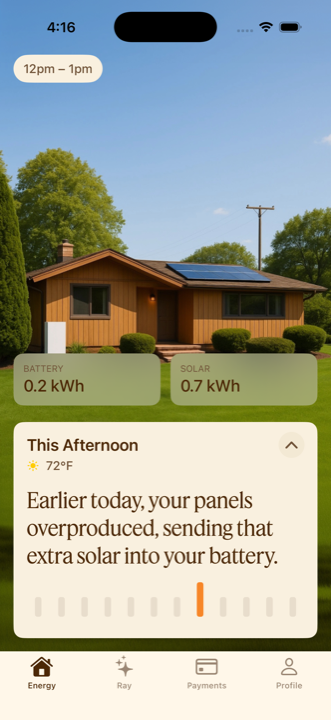
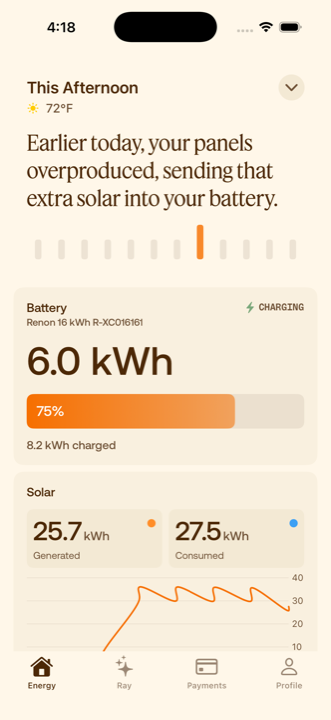
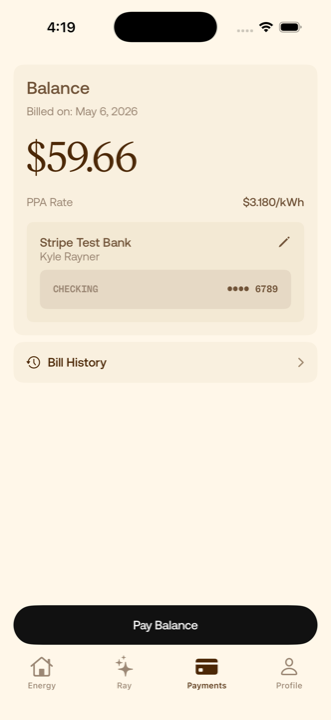
After activation, Daylight lives on the homeowner's phone. The iOS app is where they pay their bill, watch their panels produce, see their battery charge and discharge, and understand their home's energy in real time — down to per-device production and storage.
During grid events, the app shows homeowners how their system is responding — riding through severe weather, avoiding blackouts, keeping the power on. The category's history made people feel sold to; the app is designed to make them feel informed.
B2C · iOS
The home's energy, made legible.
Home & energy
Energy breakdown
Payments
Surface 03 · Money in
Billing that earns trust
Billing doesn't start until the system is verified as energized. From that anchor date, billing runs in contract months with a fixed rhythm: statement, due date, autopay. The amount itself is dynamic — it reflects the system's expected seasonal production, the contract's annual escalator, and even long-run panel degradation — but none of that lands on the homeowner. They connect a bank account once, autopay handles the rest, and the bill arrives predictably every month.
The engineering under it is built for money-grade correctness: a project can never be billed twice for the same period, payments can't double-fire, and every failure state — a bank account that won't verify, a returned payment — resolves to a clear notice and an easy way back.
Billing · what anchors vs. what repeats
Anchored to power-on. Steady every month after.
Day 0System energized
Month 1First bill
Year 2Escalator steps
Year 3+Annual cycles
Every month, fixed
1Statement
2Due date
3Autopay runs
4✓Paid
The machinery never reaches the homeowner. Just the same bill, every month.
Billing · under the hood
Every bill is a model, not a flat fee.
Contract rate
The price per unit of energy, set in the agreement.
×
Seasonal production
Expected output, month by month, for the home's region.
×
System health
Long-run panel degradation, priced in from day one.
↑ steps once a year
Annual escalator
The contract's yearly rate step, compounding on each anniversary.
A predictable monthly bill
All of it computed for the homeowner. None of it their problem.
Surface 04 · Money out
Paying the parties
A solar project isn't just billed — it pays out. Installers and sales organizations earn milestone payments as a project hits real construction gates: contract signed, work ordered, system installed, utility approval granted.
I designed the system that generates those invoices automatically from project events and moves them through a multi-role approval chain — operations, capital markets, disbursement — with versioned, encrypted banking details and a full audit trail on every decision.
This is the unglamorous half of trust: the homeowner-facing promise only holds if the six other people touching the project get paid correctly, on schedule, every time.
Partner payments · the money the homeowner never sees
Project events trigger payouts. Every payout earns its approval.
Milestones · trigger invoices
Contract signed
Work ordered
System installed
Utility approval
Approval chain · every invoice
Operations reviewWork verified
Capital marketsFunding source
DisbursementPayment run
PaidConfirmed & logged
Every decision logged · banking versioned & encrypted
Surface 05 · System
The design system
Solar software looks like the industry's reputation: dated, dense, transactional. We built the design system to be the opposite — scalable, tasteful, joyful. We thought hard about how energy should be represented: warm instead of clinical, confident instead of salesy.
The system spans the web portal and iOS, with rapid prototyping workflows and 0-to-1 principles that let a small team ship fast without losing craft. I move between Figma, prototype, and production code daily. The diagrams on this page are built in it — the case study is the demo.
How I work
Running the floor
I ran product as founding product engineer and manager: a team of four engineers plus marketing, organized into pods working in parallel, with ticketing, roadmaps, and review discipline I set up and maintained.
I stayed deeply embedded in every body of work — designing the surfaces, architecting the backend, writing the systems briefs that aligned external partners — while translating leadership's vision into a shippable roadmap. Connective tissue, not a layer of management.
Outcomes
Traction
Since going live, homeowners have signed 200+ agreements, and six construction organizations run their operations in the portal — a close feedback loop we've been iterating with ever since.
Those numbers validated the original product bets, and now they're compounding with scale. Design is never done; we're still learning every week.
In motion
What's next
Two things are in motion: a field companion app for sales reps — origination in your pocket, for getting leads in and moving deals from anywhere — and DayFi, our work bringing solar agreements on-chain.
The through-line
Why it matters
Daylight is the clearest proof of the thing I do best: modeling a genuinely complex, regulated, multi-party system — and shipping the surfaces that make it feel simple and trustworthy to every person inside it.
That same instinct is exactly what energy and AI need next.